FX markets are often described as fast, liquid, and highly efficient. Despite trillions of dollars traded daily, currency markets are frequently range-bound for months, until suddenly they do not. Breakouts, regime shifts, volatility explosions, and long-lasting trends all seem to appear without warning. This creates a false impression that the currency markets are chaotic or dominated by technical randomness.
In reality, FX markets are highly structured and price changes only when the underlying incentives to hold, fund, or exchange currencies change.
In this article, we discuss the following foundational thesis: FX markets change only when incentives change. Price action, technical patterns, and sentiment are secondary expressions of this process, not its cause. Prices move after incentives shift, not before. These changes in incentives directly influence supply and demand for currencies. When incentives shift, market participants adjust their behavior, leading to price movements.
FX Markets as Incentive Systems
At its core, the FX market is not a market of absolute value; it is a relative valuation system. Every exchange rate expresses the relative attractiveness of one currency compared to another at a given point in time.
Each participant enters the market with a motivation, and that motivation alters how they price currencies in the market. Often these participants act based on incentives shaped by their mandates:
- Central banks manage monetary stability, inflation, and financial conditions.
- Commercial banks facilitate liquidity and manage balance sheet exposure.
- Corporations hedge currency risk arising from trade and investment.
- Asset managers and sovereign funds allocate capital globally.
- Speculators seek return by anticipating changes in relative currency value.
Despite their differences, all participants respond to a common incentive framework that includes:
- Yield (interest rate differentials)
- Risk (volatility, drawdown potential, tail risk)
- Liquidity (depth, funding access)
- Policy credibility (central bank consistency and constraints)
- Capital mobility (regulation and flow restrictions)
When this framework remains stable, exchange rates fluctuate within well-defined boundaries. When it shifts, markets must reprice.
In other words, when incentives remain stable, price consolidates, and when incentives shift, markets move either up or down.
As long as these incentives remain stable, price fluctuates but structure does not change.
Markets will only reprice when the relative reward–risk shifts.
What Constitutes an Incentive Shift
Incentive shifts are not random; they emerge from identifiable structural changes. The main incentives include:
Monetary Policy Changes
Central banks and regulators don’t just affect FX markets through rates — they influence risk models, capital controls, reserve requirements, and sovereign wealth fund mandates. When these incentives change, markets change with them.
Examples:
- China’s tightening of capital controls affects CNY liquidity and forward premiums.
- A shift in a central bank’s FX reserve accumulation targets alters supply and demand balance.
- Macro-prudential regulation affects banks’ foreign exchange risk appetite.
These are structural shifts in incentive mechanisms, not merely short-term speculative drivers. They lead to persistent changes in market dynamics.
The unexpected rate decisions, forward guidance revisions, or balance sheet policy shifts directly alter the cost and reward of holding currencies.
Interest Rate Differentials
Changes in expected yield — not current rates alone — drive capital reallocation through spot, forward, and swap markets. FX markets are profoundly affected by interest rate differentials. Traders engage in carry trades — borrowing in low-yielding currencies and investing in high-yielding ones.
However, these wind up not being continuous drivers of change:
- When rate differentials are stable, carry flows persist and exchange rates appreciate gradually.
- Only when central banks change interest rates or signal future shifts does the incentive structure alter substantially.
This explains why central bank policy announcements create such outsized moves in FX — they change the incentive to hold a given currency for yield.
In simple terms: If the cost of holding a currency changes, so does its demand.
Speculative Incentives: Markets Move When Expectations Change
Speculators trade FX because they expect future movements. In efficient markets, prices reflect current expectations about the future. So the question becomes:
When do expectations change?
Expectations change only when new information alters the incentives to hold one currency over another — news releases, economic shocks, geopolitical events, shifts in risk sentiment. These incentives don’t change continuously — only episodically.
This is why:
- A sudden unemployment beat rattles EUR/USD,
- Unexpected CPI prints turbo-charge USD/JPY,
- And extended periods of quiet economic data lead to range-bound trading.
Why? Because new data changes traders’ expectation of future currency values, and hence changes their incentive to buy or sell.
Hedging Incentives: Real Economic Motivations
Corporations and financial institutions don’t trade FX to make a quick profit; they trade to manages risk.
A European exporter with U.S. dollar receivables hedges by booking forward contracts. Their incentive isn’t speculative gain — it’s to lock in expected currency values to protect cash flows.
Important point:
- Hedging flows are relatively stable and gradual unless underlying economic conditions change sharply.
- Only when corporate outlooks or trade patterns shift do hedging incentives — and therefore FX flows — change.
For example:
- A sudden export slowdown in China alters hedging demand for CNY and its trading partners’ currencies.
- A shift in global supply chains transforms demand for cross-border currency hedges.
The key is that hedgers trade because their business incentives change, not because the FX market itself has “decided” to move.
Market Dynamics Change Only When Incentives Change
The broader insight is this:
FX prices change when the cost–benefit trade-off of holding or exchanging currencies changes.
A currency’s price reflects a collective balancing of incentives: who wants it, who doesn’t, who fears risk, who seeks yield, who needs to hedge.
When these incentives don’t shift, prices tend to consolidate or revert. When they do shift, prices react — sometimes gently, sometimes violently.
This is why:
- Markets don’t trend indefinitely without incentive shifts.
- Quiet markets often precede major catalysts — policy decisions, macro releases, economic surprises.
- High volatility periods correlate with rapid incentive rebalancing across participants.
Only when one or more of these elements change does the incentive framework break, forcing repricing.
Why Prices Stay Range-Bound Without Incentive Change
In Forex markets, extended periods of range-bound or consolidation behavior are not market anomalies; they are the natural state of markets operating under stable incentives.
In such environments:
- Monetary policy paths are predictable
- Rate differentials change slowly
- Growth expectations converge
- Capital flows remain balanced
Hedging activity from corporates and long-term investors dampens volatility, while speculative flows focus on short-term mean reversion rather than directional conviction. Technical levels appear to “hold” not because they possess intrinsic power, but because no participant has a compelling incentive to force price beyond equilibrium.
In the absence of incentive change, attempts at sustained breakouts typically fail, reverting price back toward balance.
Why Technical Analysis Fail Without Incentive Context
Technical patterns describe price behavior — they do not cause it.
A breakout only holds if:
- Incentives support capital follow-through
A support level only matters if:
- Incentives discourage further selling
This explains why:
- Some breakouts fail instantly
- Some trends persist despite “overbought” signals
Price action is the footprint of incentive shifts — not the driver.
Why Technical Analysis Works Only After Incentives Shift
Technical analysis does not cause price movement; it reflects market behavior. Patterns succeed when they align with incentive-driven flows and fail when they do not.
Breakouts require capital follow-through. Support levels hold when selling incentives are exhausted. Without incentive confirmation, technical signals lack durability.
Remember: “Price is the messenger — incentives are the message.”
The Core Principle for FX Traders and Macro Thinkers
To understand FX markets, stop asking:
“Where will price go?”
Start asking:
“What incentive has changed — and for whom?”
Ask:
- Did yield differentials change?
- Did policy credibility change?
- Did capital mobility change?
- Did risk pricing change?
If the answer is “no,” expect consolidation.
If the answer is “yes,” expect repricing.
Examples: Incentive-Driven FX Moves
The 2022 USD Supercycle — A Yield Incentive Shock
What Happened
In 2022, the U.S. dollar strengthened aggressively against nearly every major currency:
- EUR/USD collapsed
- USD/JPY surged beyond 150
- EM currencies weakened broadly

The Incentive Shift
The Federal Reserve executed the fastest rate-hiking cycle in decades, while:
- ECB lagged
- BoJ remained ultra-dovish
- Global growth slowed
This created a structural yield incentive:
- Holding USD suddenly paid far more than holding EUR, JPY, or CHF
- Cash itself became an attractive asset again
Why the Market Had to Move
This was not a “strong dollar narrative.”
It was an incentive realignment:
- Global capital repriced the cost of funding
- Carry trades reversed
- Hedging demand for USD surged
- Reserve managers increased USD allocation
As long as the yield differential persisted, USD strength persisted. The dollar didn’t rise because traders were bullish — it rose because holding dollars became structurally more rewarding.
EUR/USD Stagnation (2015–2021) — Incentive Stasis
What Happened
For nearly six years, EUR/USD oscillated broadly between 1.05 and 1.25 with no sustained trend.

Why This Confused Traders
Retail traders blamed:
- “Manipulation”
- “Algorithms”
- “False breakouts”
But nothing was broken.
The Incentive Reality
- Fed and ECB policy divergence was slow and predictable
- Growth differentials were modest
- Capital flows were balanced
- No existential euro risk was priced
In short: no incentive shock existed.
Speculators traded ranges, hedgers maintained flows, and long-term capital had no reason to reallocate aggressively. Without a change in incentives, FX markets default to mean-reverting equilibrium.
Swiss Franc Shock (2015) — Policy Incentive Collapse
What Happened
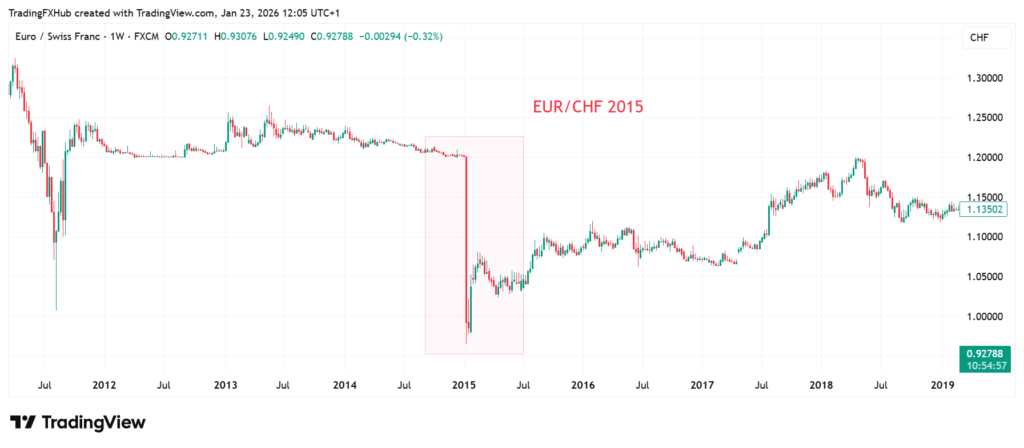
In January 2015, the Swiss National Bank removed its EUR/CHF floor without warning.
EUR/CHF collapsed nearly 30% intraday.
What Actually Changed
The SNB had been:
- Absorbing EUR supply
- Penalizing CHF strength
- Guaranteeing a price floor
This created a negative incentive to hold CHF.
The moment the floor was removed:
- Holding CHF became risk-free appreciation
- EUR exposure became asymmetric downside
Every incentive flipped instantly.
Why the Move Was So Violent
- Carry trades were forced to unwind
- Liquidity evaporated
- Price gapped to a new equilibrium
When a policy incentive disappears, FX markets do not adjust gradually — they reprice discontinuously.
USD/JPY (2021–2024) — One-Sided Policy Incentives
What Happened
USD/JPY trended relentlessly higher for years.

The Structural Incentive
- Fed tightened aggressively
- BoJ maintained Yield Curve Control
- Japanese investors sought yield abroad
- Hedging costs rose, discouraging repatriation
The incentive was one-directional:
- Borrow JPY
- Buy USD assets
- Hedge selectively (or not at all)
Even massive FX intervention by Japan only caused temporary pullbacks.
Why?
Because intervention did not change the incentive — it only altered price temporarily. FX intervention fails when it does not alter the underlying incentive structure.
GBP Collapse After Brexit — Capital Flow Incentives
What Happened
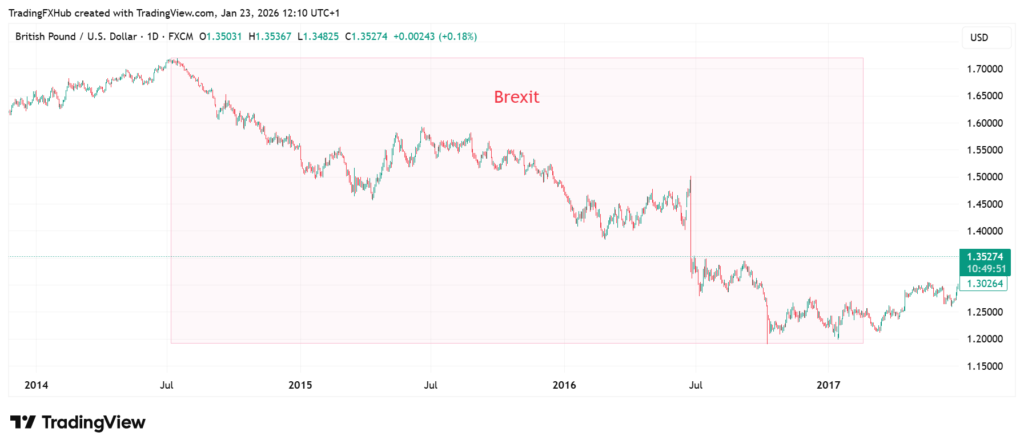
Following the Brexit vote, GBP experienced a sharp and persistent devaluation.
What Changed
- Expected trade flows deteriorated
- Foreign direct investment uncertainty rose
- UK risk premium expanded
- Capital demanded higher compensation to stay
This was not panic — it was repricing of capital allocation incentives.
Global investors required:
- Cheaper GBP
- Higher yield
- Policy clarity
Until those incentives stabilized, GBP could not sustainably recover.
Identifying Incentive Changes in Real Time
To identify genuine market shifts, focus on structural indicators rather than price alone:
- Central bank communication and credibility
- Interest rate expectations (OIS and futures)
- Yield differentials and forward curves
- Balance-of-payments and capital flow data
- Risk pricing through volatility and credit spreads
The goal is diagnosis, not prediction — understanding whether the incentive framework has changed or remains intact.
Conclusion
In Forex, price tells you that something has changed. Incentives tell you why.
Understanding FX markets requires shifting focus from price charts to incentive structures. Price movements are symptoms — incentives are the cause.
To interpret FX movements:
- Ask “Which incentives changed?”
- Not “Why is the market moving?”
- But “What changed that made holding (or selling) this currency more (or less) attractive?”
Incentive changes — whether due to policy moves, economic surprises, risk sentiment shifts, or interest rate realignments — are the true drivers of FX market behavior.
They are adaptive systems that reprice currencies only when incentives shift.
Once you learn to identify:
- Policy incentive changes
- Yield regime shifts
- Capital flow realignments
- Risk premium repricing
You stop chasing price — and start understanding why markets move at all.
That is the difference between trading FX and reading FX.