Foreign exchange markets do not move in straight lines because of headlines. They move in extended arcs when capital reallocates across jurisdictions for structural reasons. A multi-month FX campaign is not simply a strong trend. It is a sustained repricing process driven by relative macro conditions, liquidity capacity, and cross-border flow dynamics.
Understanding its anatomy allows you to recognize where you are in the process — rather than reacting to what price has already done.
FX Campaigns Are Structural, Not Narrative
Market commentary tends to explain prolonged currency moves through simplified macro stories: rate differentials, inflation surprises, political risk. These explanations often emerge after the move is underway.
A campaign, however, begins before the narrative stabilizes. It forms when capital decides that relative value between two jurisdictions must adjust over time. The trend you see on a chart is the visible expression of that capital shift.
The core thesis is simple:
A multi-month FX campaign is a sustained cross-border capital reallocation process expressed through price.
Direction is secondary. Structure is primary.
The Precondition: Regime Alignment
A campaign cannot begin in isolation. Certain structural alignments must exist first.
Macro Divergence
Policy divergence, growth differentials, inflation dispersion, and yield spread expansion create the foundation. But divergence alone is insufficient. Markets frequently price divergence without sustaining a campaign.
What matters is whether divergence is persistent enough to justify repositioning capital over quarters, not weeks.
Liquidity and Balance Sheet Conditions
Liquidity determines whether repricing can extend. If funding markets are stable and balance sheets can absorb positioning, campaigns develop smoothly. If absorption capacity is fragile, moves truncate quickly.
Liquidity does not create the theme — it determines its durability.
Positioning Vacuum
Campaigns rarely start from extreme consensus. They often begin when positioning is neutral or when prior crowding has recently unwound. Structural repricing needs space to develop.
Without room for inventory accumulation, campaigns struggle to gain traction.
Phase One: Accumulation and Early Repricing
The first phase is subtle.
Institutional participants begin shifting exposure quietly. Volatility remains contained. Ranges compress before gradually expanding in one direction.
Data releases begin producing asymmetric reactions. Strong data in one jurisdiction pushes the currency decisively; weak data in the opposing jurisdiction accelerates follow-through.
At this stage, most market participants still view price action as noise. The campaign has begun — but it is not yet obvious.
Phase Two: Recognition and Momentum Expansion
Eventually, the theme consolidates.
Sell-side research aligns around a dominant macro narrative. Media reinforces it. Systematic and momentum-driven strategies engage.
Volatility expands. Breakouts appear clean and sustained. Yield spreads and rate expectations reinforce the move.
This is where most traders believe the campaign starts. In reality, it is already mid-process. The early structural repricing has been validated. Participation broadens.
The move feels obvious — and therefore powerful.
Phase Three: Saturation and Structural Maturity
Campaigns mature quietly.
Positioning becomes concentrated. Commitment of Traders data often shows extremes. Risk is skewed.
Marginal data surprises generate smaller price extensions. The market requires stronger catalysts to push further.
Cross-asset confirmation weakens. Equity indices, bond markets, and commodities stop reinforcing the currency move as clearly as before.
Price may still trend. But structurally, repricing is near completion.
This is where many confuse continuation with strength.
The Illusion of Trend Persistence
Late participation sustains visible direction even after structural repricing has largely completed. Redistribution replaces fresh conviction.
Liquidity begins thinning beneath the surface. Stability depends on continuation rather than new capital.
Trends can persist long after campaigns are functionally complete.
This distinction matters. Campaign completion does not require reversal.
The Termination: Completion Without Collapse
A multi-month FX campaign usually ends through exhaustion, not drama.
Repricing reaches its logical boundary. Forward expectations are fully embedded. Relative value gaps close.
Volatility shifts from directional expansion to two-way movement. Consolidation replaces extension. Carry may persist, but momentum fades.
The market transitions into stagnation or regime shift.
Reversal is optional. Completion is structural.
What Actually Ends a Campaign?
Campaigns end when the logic behind cross-border capital reallocation loses coherence.
This can happen through:
- Policy expectation shifts (not necessarily policy action)
- Liquidity constraint changes
- External shocks that reorder capital priorities
- Yield convergence that removes relative advantage
When the incentive to hold one currency over another weakens structurally, the campaign dissolves.
Historical Example: The U.S. Dollar Cycle (2021–2022)
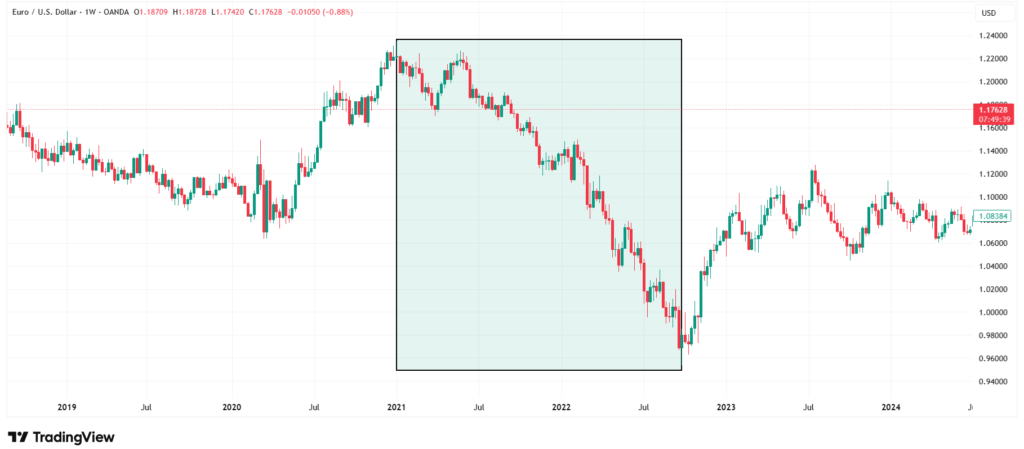
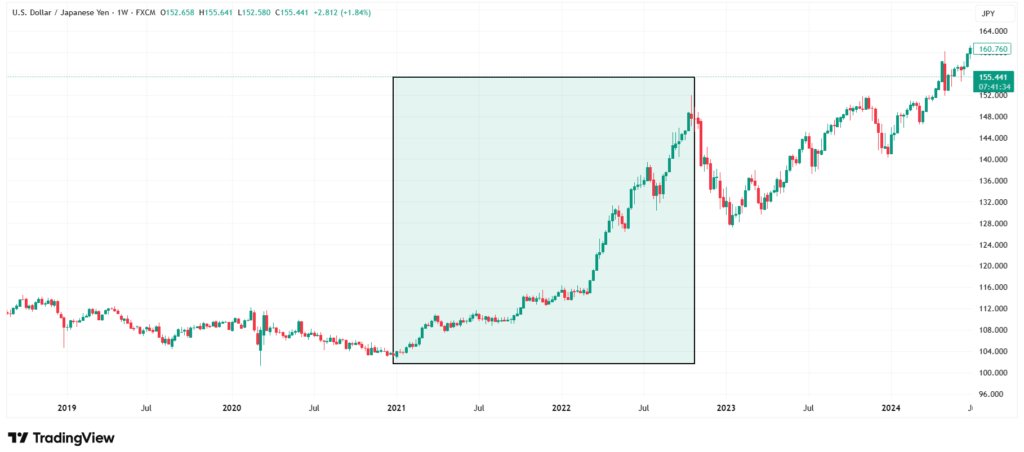
A clear example of a multi-month FX campaign occurred during the U.S. dollar surge of 2021–2022.
Precondition: Regime Alignment
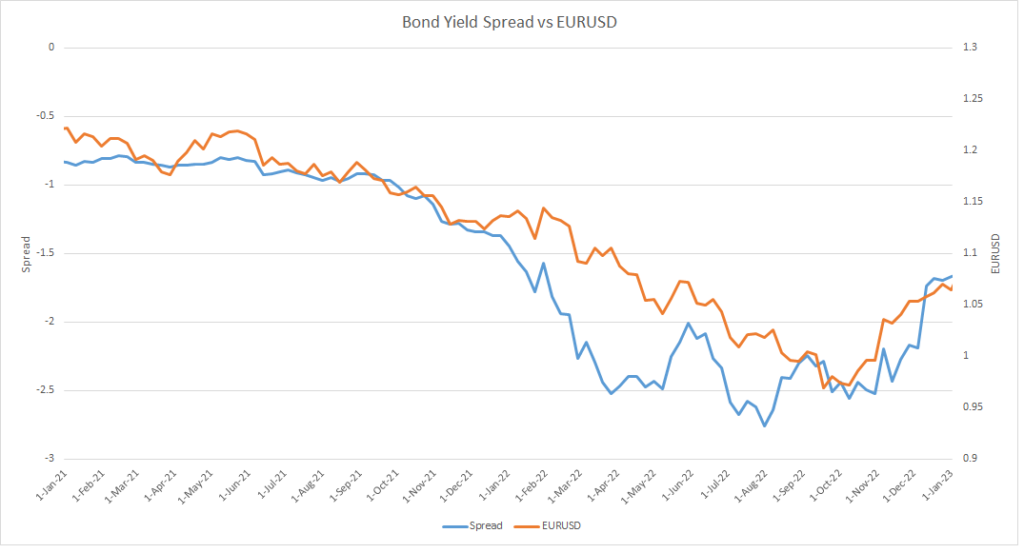
Following pandemic stimulus and inflation acceleration, the Federal Reserve pivoted toward aggressive tightening. Rate differentials between the United States and Europe widened sharply.
Meanwhile, the European Central Bank remained comparatively slower to tighten policy.
Growth dispersion and yield divergence created structural alignment for USD strength.
Phase One: Early Repricing
In early 2021, USD appreciation began quietly. Volatility remained moderate. Many market participants viewed the move as temporary dollar strength rather than a structural campaign.
Yield spreads began widening, and the dollar responded asymmetrically to inflation surprises.
Phase Two: Recognition
By early 2022, the theme had consolidated. The Fed’s tightening path became explicit. Media narratives centered on “policy divergence.” Systematic funds increased USD exposure.
The euro declined steadily. USD/JPY accelerated. Broad dollar indices surged.
Volatility expanded, and momentum became self-reinforcing.
Phase Three: Saturation
By late 2022, positioning was crowded. The euro approached multi-decade lows near parity with the dollar. USD strength felt structural and unstoppable.
However, marginal repricing diminished. Smaller data surprises produced limited extensions.
Forward expectations had already embedded peak Fed tightening.
Termination Without Immediate Collapse
The campaign did not end with a violent reversal. Instead, it transitioned into consolidation as inflation moderated and rate expectations stabilized.
The dollar stopped appreciating aggressively before policy actually reversed.
The campaign had completed its repricing logic.
Diagnostic Framework: Identifying Campaign Stage
To assess where a currency pair stands within a campaign:
- Examine regime alignment: Is divergence persistent and durable?
- Evaluate liquidity conditions: Can balance sheets absorb continuation?
- Observe positioning concentration: Is risk asymmetric?
- Assess marginal reaction: Do strong catalysts produce diminishing extensions?
- Monitor cross-asset confirmation: Are bonds, equities, and commodities aligned?
The goal is not prediction. It is structural awareness.
Implications for Campaign-Based Trading
Early-stage campaigns require conviction and structural clarity.
Mid-stage campaigns require discipline and trend management.
Late-stage campaigns require restraint.
The greatest risk occurs when maturity is mistaken for strength.
Campaign thinking shifts focus from entry timing to structural phase recognition.
Conclusion: Campaigns Are Capital Movements
Multi-month FX campaigns are not chart formations. They are capital movements across borders driven by regime alignment and liquidity conditions.
Trends are visual. Campaigns are structural.
When you understand the anatomy of a campaign, you stop reacting to price and start observing process.
Currencies do not move because narratives sound convincing.
They move because capital decides it must relocate.
And once that relocation completes, the campaign quietly ends.