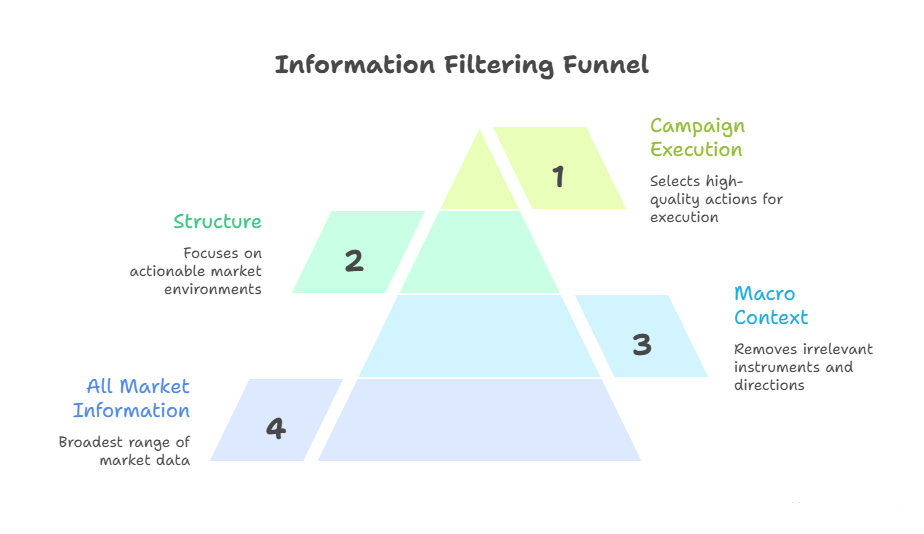
Most traders do not fail because they lack information, they fail because they have too much of it, and no hierarchy to organize it. Economic data, technical indicators, sentiment readings, positioning reports, and price patterns all compete for attention at the same time. The result is confusion, overtrading, and a constant feeling of reacting rather than acting.
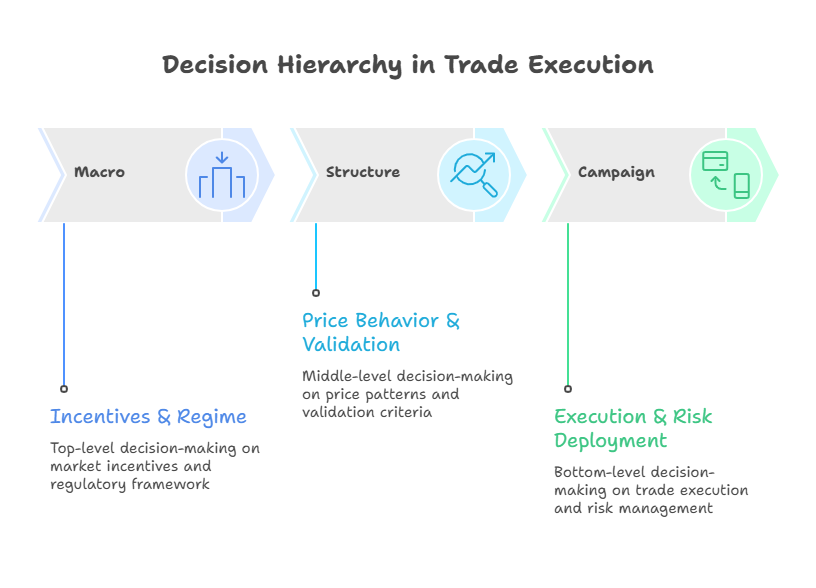
The Macro → Structure → Campaign model exists to solve this problem. It is not a strategy, an indicator, or a set of entry rules. It is a decision framework that defines how information should flow and when each type of analysis is allowed to influence trading decisions. At its core, the model is built on a simple idea: markets must be understood from the top down. Macro defines the regime, structure reveals how that regime expresses itself in price, and campaigns are the disciplined way to participate while those conditions persist.
Macro: Defining the Regime
Macro analysis is the highest layer of the model, and also the most misunderstood. Macro is often reduced to reacting to news headlines or guessing the outcome of the next data release. In reality, macro is not about events; it is about incentives.
Currencies move when holding one currency becomes structurally more attractive than holding another. This attractiveness is shaped by monetary policy, interest rate differentials, liquidity conditions, inflation dynamics, and capital flows. These forces evolve slowly and tend to dominate price behavior over weeks, months, and sometimes quarters.
The purpose of macro analysis is not to predict tomorrow’s candle. Its purpose is to determine whether a market is in an environment that encourages accumulation, distribution, or stagnation. A widening rate differential, for example, creates a persistent incentive for capital to flow in one direction. Tightening liquidity can suppress volatility and trap price in ranges, while easing liquidity often allows trends to extend further than most traders expect.
When macro analysis is done correctly, it produces three outputs. First, it defines a directional bias or lack thereof. Second, it establishes a time horizon, clarifying whether patience or tactical trading is required. Third, it frames the risk environment, helping the trader understand whether trends are likely to persist or fail quickly. Macro answers a single, critical question: Should this market even be traded, and if so, from which side?
Structure: Translating Incentives into Price Behavior
Macro alone is never enough. Markets can remain misaligned with macro incentives for long periods, and price often moves in ways that appear contradictory in the short term. This is where structure becomes essential.
Market structure is the mechanism through which macro forces express themselves in price. It is not a collection of patterns or setups, but an observation of behavior. Is price expanding or compressing? Are pullbacks being absorbed or rejected? Do ranges resolve quickly or persist stubbornly? These questions matter far more than any single indicator reading.
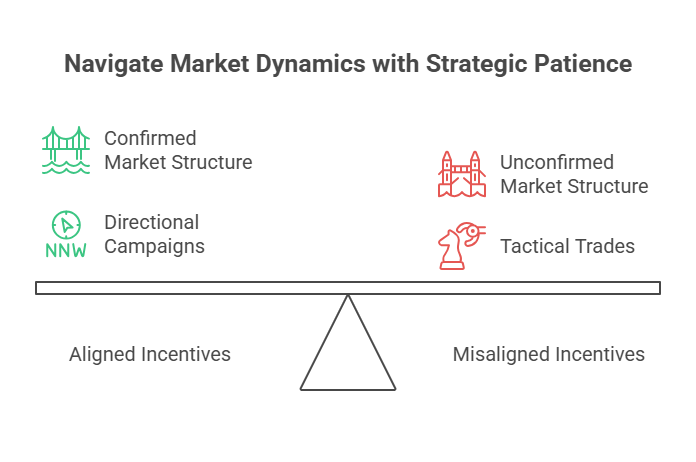
Structure acts as the bridge between theory and reality. A strong macro bias without structural confirmation is nothing more than an opinion. Likewise, clean technical patterns without macro support tend to fail unpredictably. Structure provides evidence that market participants are acting in line with the incentives identified at the macro level.
Over time, markets cycle through recognizable structural phases. Accumulation reflects quiet positioning, often when macro incentives are shifting but not yet widely recognized. Markup and markdown represent directional expression once participation expands. Distribution appears when incentives begin to erode and smart capital exits into strength. Observing these phases allows the trader to assess whether the macro thesis is being validated or challenged by price itself.
Structure answers a different question than macro: Is the market behaving in a way that supports continued participation, or is patience still required?
Campaign: Executing with Intent, Not Impulse
Once macro defines the regime and structure confirms participation, the final layer of the model becomes active. This is the campaign.
A campaign is not a single trade. It is a deliberate, ongoing engagement with a market while conditions remain favorable. Instead of searching for perfection in one entry, campaigns focus on consistency across multiple executions. They allow traders to scale, re-enter, reduce exposure, or stand aside, all within a coherent plan.
Campaigns are defined by bias, not by signals. They include clear invalidation points, risk limits, and expectations about behavior. In a trend-friendly environment, a campaign may involve buying pullbacks repeatedly as long as structure remains intact. In range-bound conditions, the campaign may focus on fading extremes or reducing position size altogether. Transitional campaigns, often the most difficult, require flexibility as structure evolves ahead of macro confirmation.
Risk management at the campaign level is what separates professional behavior from amateur trading. Losses are expected, but they are contextualized. A failed trade does not invalidate the campaign unless structure itself breaks. This perspective dramatically reduces emotional decision-making and prevents overreaction to normal market noise.
Campaigns answer the final question in the model: How do I participate consistently without forcing trades?

The Direction of Information Flow Matters
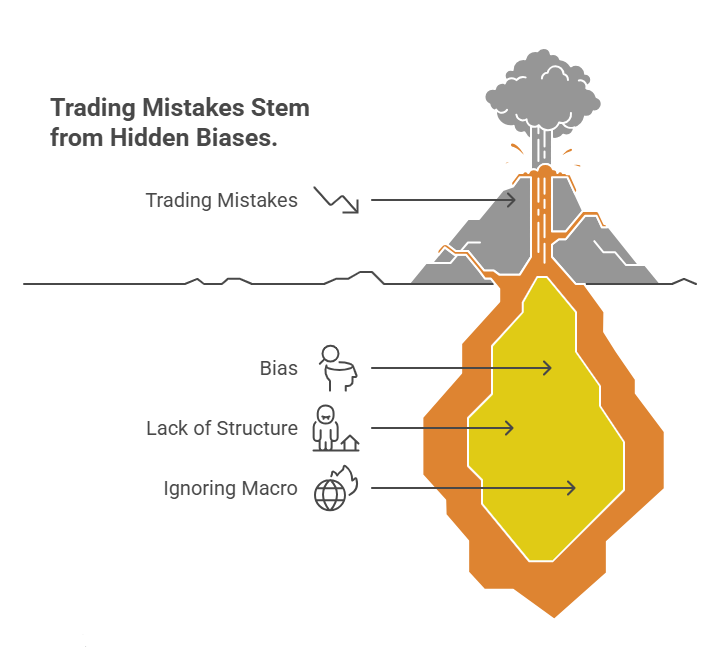
The power of the Macro → Structure → Campaign model lies in its directionality. Information must flow from macro to structure to execution. Reversing this flow is the root of most trading mistakes.
Starting with campaigns without macro context leads to overtrading and randomness. Relying on structure without understanding incentives results in false breakouts and fragile trends. Holding strong macro views without structural confirmation often leads to premature positioning and unnecessary drawdowns.
When the layers are aligned, trading becomes quieter. Fewer decisions are needed, patience increases naturally, and confidence comes from process rather than prediction.
Benefits of the Model
The primary benefit of the Macro → Structure → Campaign model is clarity. By imposing a strict hierarchy on information, the model removes the noise that causes most traders to overreact and overtrade. Instead of evaluating everything at once, decisions are filtered logically: macro defines whether a market is worth engaging, structure determines whether participation is justified, and the campaign governs how risk is deployed over time.
This separation reduces emotional decision-making, increases patience, and prevents the common mistake of forcing trades in unfavorable conditions. Over time, the model creates consistency not by predicting outcomes, but by ensuring that every action taken in the market is context-aware, repeatable, and aligned with the dominant incentives driving price.
A Framework, Not a Forecast
This model does not claim to predict the future. Instead, it organizes uncertainty. It accepts that markets move because incentives change, that price confirms those changes over time, and that participation should be deliberate rather than reactive.
By separating analysis into macro, structure, and campaign, traders stop asking, “Where will price go next?” and start asking, “What is the market inviting me to do right now?” That shift alone is enough to transform how trading is experienced.
In the end, successful trading is not about finding better setups. It is about managing campaigns inside regimes, respecting structure, and letting macro do the heavy lifting. The Macro → Structure → Campaign model is simply a way to make that process explicit, repeatable, and sustainable.